
The first post in my new RTW Planning Series
Planning a round-the-world trip sounds romantic, spontaneous, maybe even a bit chaotic – but the reality (at least for me) involves spreadsheets, fare rules, and more browser tabs than I’m comfortable admitting publicly.
If you’ve already read my overview – Around the World in 23 Days: My Biggest Adventure Yet – you’ll know the broad strokes of my 2026 adventure. But what that post didn’t dive into is the how.
Because planning this kind of trip isn’t the same as bunging a few one-ways together on Skyscanner. It’s a puzzle. A game. A complicated piece of airline fare engineering. And honestly? It’s half the fun.
This post is the start of a deeper series on planning my route, picking flights, choosing cities, and navigating the strange little world of Round-the-World (RTW) tickets – specifically the OneWorld Explorer / DONE4 style fare I’m using to pull this off.
What Even Is a Round-the-World Ticket?

An RTW ticket is exactly what it sounds like: a single airfare that lets you circumnavigate the planet with a set of rules. All three major alliances offer some flavour of it, but they differ massively in complexity, cost, and flexibility.
I’m using a OneWorld Explorer–style ticket (in booking code D — hence DONE4 for four continents). These fares are based on the number of continents visited, rather than total mileage. That makes them brilliant for someone like me who wants to zig-zag a bit without worrying about breaking a mileage cap.
A few defining features:
- You must travel in one direction (east or west). No backtracking (across continents).
- You have a limited number of segments (16).
- You can stop in each continent a set number of times.
- Everything must be flown with member airlines (BA, Qatar, JAL, Qantas, Finnair, Cathay, etc.).
- Date changes are allowed for free; routing changes are a chargeable change.
It’s flexible… but not that flexible.
Why I Didn’t Just Book One-Way Flights
You definitely can stitch together separate tickets to go around the world. Sometimes it’s even cheaper. But for my goals, an RTW ticket made much more sense:
1. I want to maximise tier points.
I’m aiming for British Airways Club Gold Status on this trip, and a DONE4 makes that almost effortless compared to random one-ways.
2. I want the “good” flights.

Qsuite. JAL’s new A350. Qatar long-hauls.
With RTW fares, you can choose premium cabins at a much lower marginal cost than buying individually.
3. One fare = massively better protection.
If a flight is delayed or cancelled, the entire itinerary is protected.
If you stitched this multiverse of flights yourself… let’s just say you’re rolling the dice.
4. More stopovers, fewer headaches.
I want to see as many places as possible. An RTW ticket lets me do that without booking 14 individual tickets.
The Puzzle: Crafting My Route Around The Rules
My final route looks like this:
Oslo → Doha → Los Angeles → New York → Tokyo → Singapore → Hong Kong → Sydney → Doha → London
But getting that to fit the actual rules involved a surprising level of Tetris.
Direction of travel
I picked westward, partly because it minimised overnight flights, and partly so that I could end with the destination I am most excited for; Sydney!
Starting in Oslo (aka: the magic of positioning flights)
Why Oslo? Because Scandinavian departure taxes and carrier surcharges are much lower, making the entire ticket cheaper. A bit of a faff, but worth it. Starting in Oslo cut my total flights cost by 33%.
Picking cities I actually want to explore
I didn’t want this to be a “tick-box, airport-only” RTW.
So I built a route where every city is either:
- somewhere I’ve always wanted to see, or
- somewhere with a unique flight product.
Best of both worlds.
The Rules That Shaped Everything
RTW fares come with some surprisingly strict constraints. These ones affected me the most:
No backtracking
Simple in theory. Nightmare in practice.
You can’t go: Los Angeles → Hawaii → New York → Tokyo.
That breaks the direction rule – it must be a clean loop. You can backtrack within a single continent (with weird exception rules for places like Hawaii) however.
Segment limits
A DONE4 gives you up to 16 flight segments.
It sounds like a lot until you realise you can eat up half of them just transiting Asia.
All flights must stay within OneWorld
If a destination is easiest to reach with Virgin Atlantic, Emirates or Lufthansa? Tough.
You have to find a OneWorld routing… or skip it.
Some cities just don’t work
Bali? Hard in OneWorld.
Tahiti? Basically impossible.
New Zealand? Piles on a shed load of Carrier imposed surcharges due to the inevitable Qantas segments.
The constraints push you into a very particular style of trip planning – it’s like building a machine that only runs with certain parts.
The AvGeek Layer: Picking the Right Aircraft
OneWorld’s RTW rules don’t stop you choosing specific products – which is where the fun begins.
Some of the highlights on my route:
- Qatar Airways QSuite: Doha → LA (the longest QSuite flight)
- JAL A350-1000: Tokyo → Singapore
- Qatar A380: Sydney → Doha
You effectively get to curate your “top 10 business-class experiences” list in one itinerary.
Why I Used a Travel Agent
I love planning trips. But I am also wise enough to know when to hand the baton to the professionals.
RTW fares are:
- fiddly
- rules-heavy
- prone to weird quirks in airline pricing systems
- difficult to ticket correctly without experience
A travel agent can:
- validate the routing
- optimise for fare rules
- issue the ticket properly
- fix things quickly if something breaks
And for a trip this big? That peace of mind is priceless.
The Tools I Used to Make It Work
A few essential parts of my RTW toolkit:
Google Flights + ExpertFlyer + FLIGHT CONNECTIONS
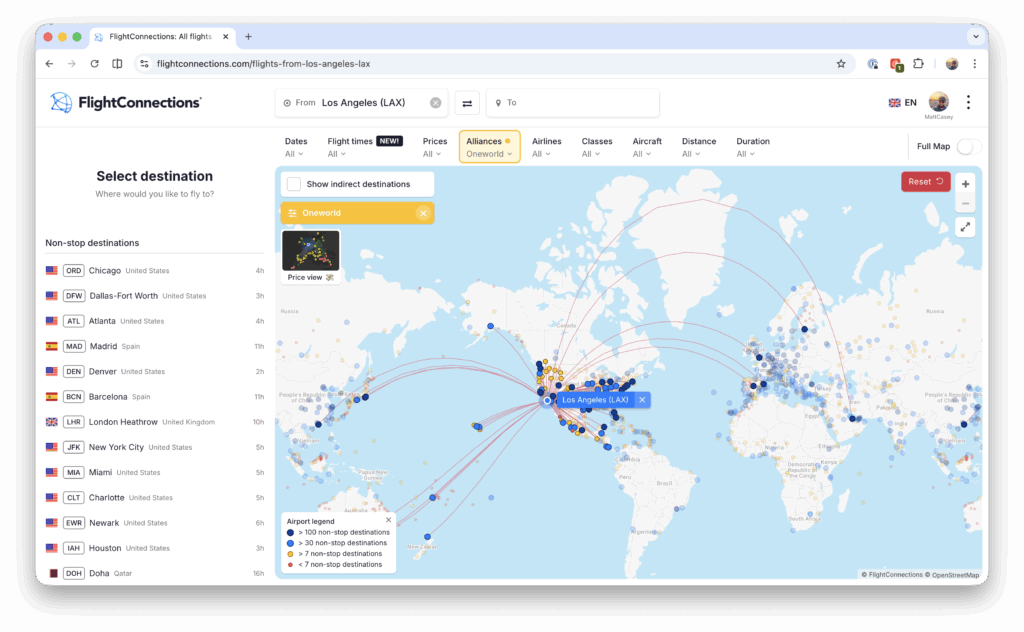
For spotting availability and routing combinations. Google flights is great for checking aircraft types, Expert Flyer is fantastic for digging in to the geeky detail of flight routings and code share availability, and FlightConnections.com (pictured above) is a life saver for figuring out what airlines fly where.
Great Circle Mapper
For making sure the total distance adds up to my target to achieve BA gold status.
A very overwrought spreadsheet
Distance calculations, time zones, flight numbers, hotels, cost projections — if it can be put in a cell, I’ve put it in a cell.
Would I Recommend an RTW Ticket?
Absolutely – but only if you enjoy the planning part.
If you want simple, spontaneous travel, RTW fares can feel very complex.
But if you’re the kind of person who:
- loves airports
- loves flight products
- loves clever routing
- loves optimising loyalty earnings
- loves visiting new parts of the world
… then a DONE4 is basically the ultimate travel playground.
It’s complicated, yes. But it’s a good complicated.
What’s Coming Next in the RTW Planning Series
Over the next few months I’ll be diving into:
- How I picked each city
- Detailed planning guides for Doha, LA, NYC, Tokyo, Singapore, Hong Kong and Sydney
- My jet-lag strategy
- The flights I chose and why
- Travel tech I’m bringing
- How I’m tracking costs and logistics
- Why loyalty status matters for a trip like this
If you’re planning your own RTW adventure — or just love a bit of aviation geekery – stay tuned.